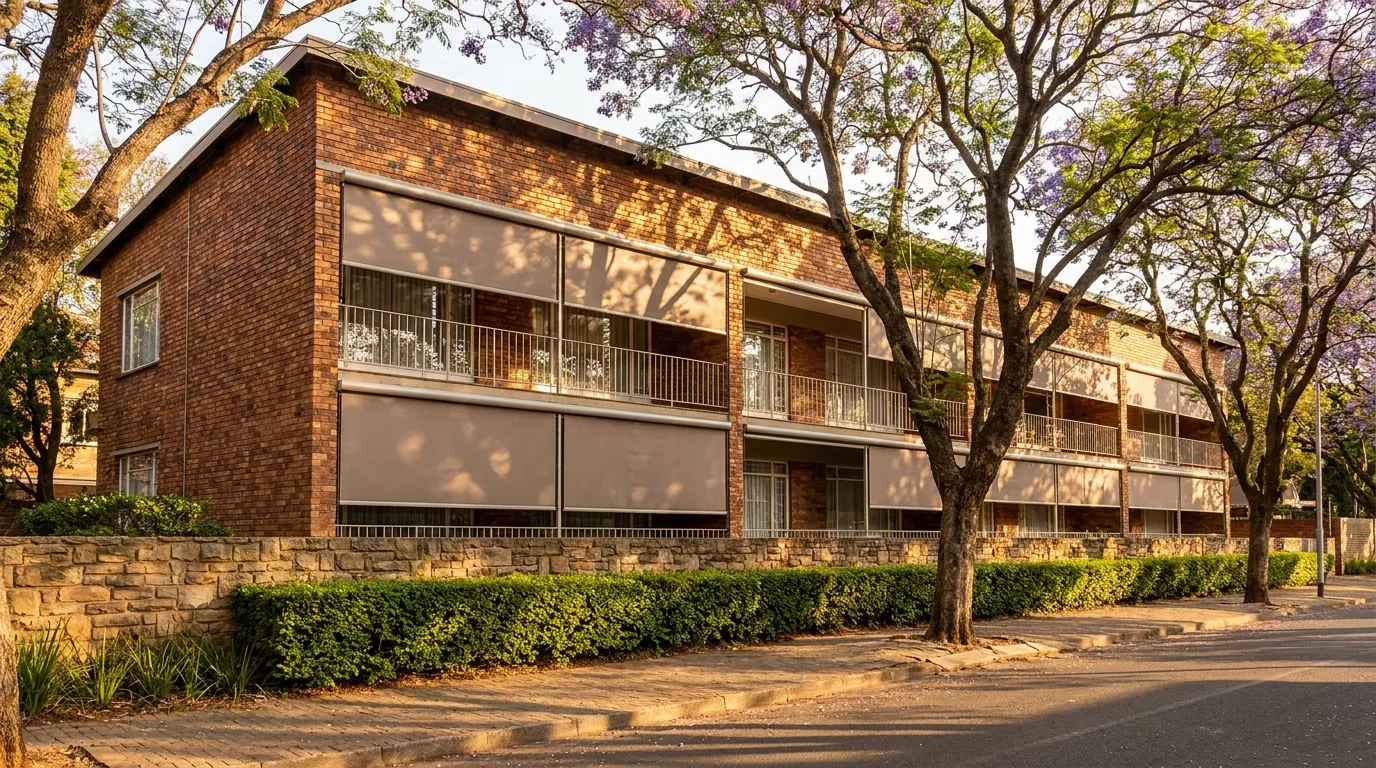
A 1950s face-brick low-rise apartment block on a jacaranda-lined Illovo street, its balcony sliding doors fitted with flat-sheet roller blinds half-lowered against the late afternoon sun

Free guide · no email needed to read it

The Illovo Light Ledger

A window-by-window account of how the sun actually behaves in this suburb — which elevations suffer, when, and what we would specify on each. Written for Illovo's 1950s blocks and its newer glass alike.

About 8 minutes 26.13° south Sources listed at the foot

01 — The short version

Illovo is two suburbs, and they need different blinds.

Illovo covers about 2.27 km² between Rosebank and Sandton, and almost every window in it belongs to one of two very different buildings. Behind the street trees stand the 1950s and '60s apartment blocks the suburb is known for — big rooms, solid walls, high and often pressed ceilings, parquet underfoot. A street away, along Oxford Road and Corlett Drive, newer clusters and glass-fronted buildings put tall glazing into the afternoon with nothing in front of it.

One fabric cannot answer both. A blind chosen for a shaded 1958 lounge under a jacaranda will fail on a west-facing slider two blocks away, and the reverse is just as true. So we work sun first, elevation second, product last — and this guide is that order, written down.

02 — The light here

One number sets everything: 26.13° south.

At solar noon on 21 December the sun stands roughly 87° above the horizon over Illovo — near enough to straight overhead that a decent roof overhang shades a north window on its own. Six months later, at noon on 21 June, the same sun is only about 41° up. It comes in low, tracks right across the northern sky, and reaches metres into the room.

The compass points move too: in midsummer the sun rises south of due east and sets south of due west; in midwinter it rises and sets north of that line, and the day is three hours shorter. A window judged only in January is under-specified by July.

21 Dec · 87° 21 Jun · 41° East North West
Summer solstice — high and wide Winter solstice — low, straight into north rooms

Three Highveld facts that change the spec

Altitude. Johannesburg sits around 1,753 m up, and UV intensity rises roughly 10% per 1,000 m; clear-sky summer UV here runs at index 11–13. That is hard on floors, upholstery and on the fabric itself — and why, where the building allows it, we would rather stop the radiation outside the glass than absorb it inside.

Storm season. October to March brings intense afternoon thunderstorms; the South African Weather Service lists heavy rain, flooding, lightning, strong wind and hail among the hazards, October and November the peak. Anything hung outside a window here is specified for that afternoon, not a calm one.

Berg winds. Winter and early spring bring dry westerly and north-westerly winds and their dust — the season when easy-clean fabric stops being a luxury.

And then the trees

Illovo's jacarandas and street trees are deciduous: free shade from about October, gone by the time the low winter sun arrives — precisely backwards from what a north-facing room wants. Tree cover here is seasonal, never permanent, so we specify as though the branches were bare.
03 — Elevation by elevation

Which of your walls is actually the problem.

Stand at the window with a compass — your phone will do.

N

North — kind, if you leave it alone in winter

Sun all year, but friendly geometry: near-vertical in summer, so an overhang or retractable screen kills it; low and deep in winter, which is free heat.

Verdict: retractable, seasonal — never fixed.
W

West — the one that costs you

From mid-afternoon the sun strikes close to square-on, and it drops rather than rises, so no overhang reaches it. This is where rooms overheat and colours fade.

Verdict: stop it outside the glass if you can.
E

East — brief, bright, a bedroom problem

The same low geometry in the morning, with less heat because the building is still cool. The complaint is never temperature; it is 05:30 in December.

Verdict: darkness on demand, not heat control.
S

South — no sun, all sky

Almost no direct beam — just even, cool sky-light, and in a suburb of stacked blocks a good number of sightlines.

Verdict: privacy and warmth, not shading.
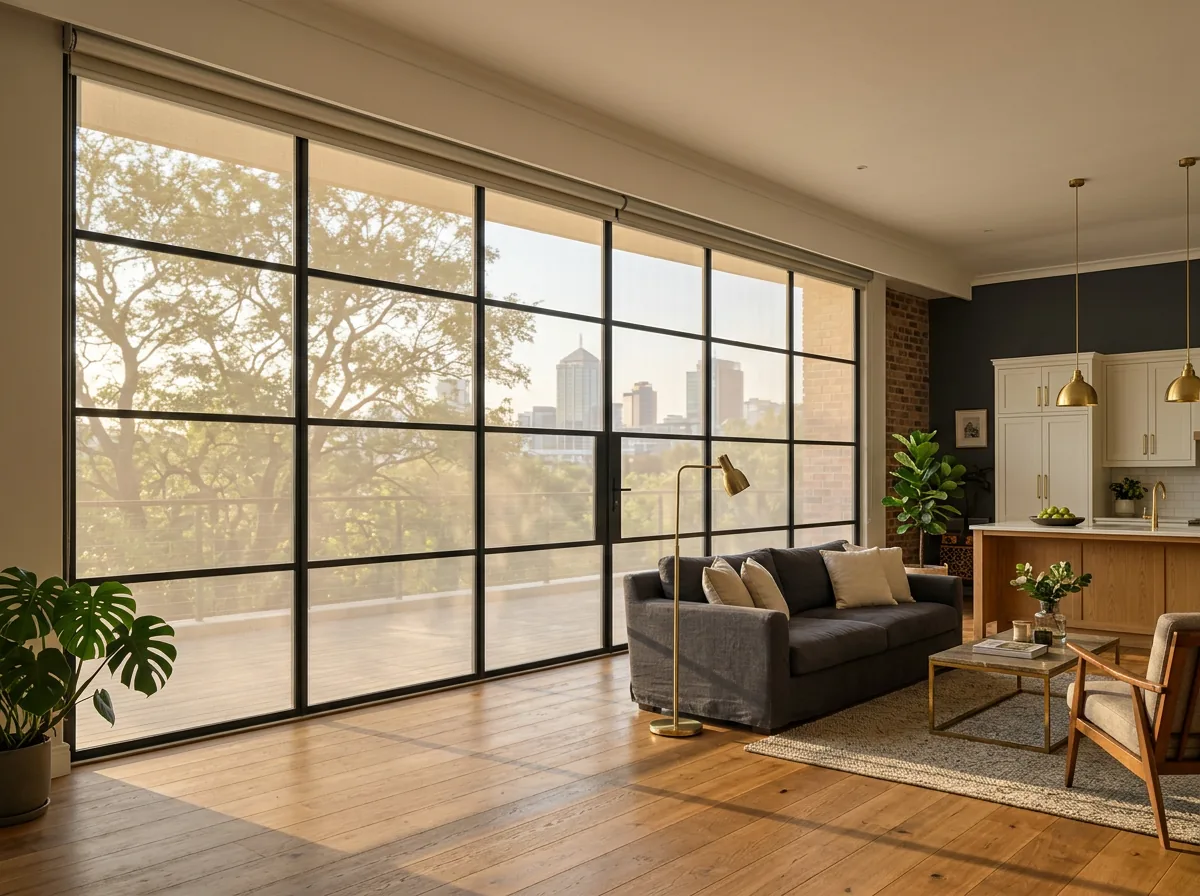
A single flat sheet of pale sunscreen mesh rolled down over a floor-to-ceiling west-facing window in an Illovo apartment, tree canopy and distant office towers still visible through the weave
West elevation, about 4pmSunscreen mesh takes the dazzle out of a low western sun while the canopy and skyline stay readable. After dark it reverses — hence the second layer.

Make it yours

Want this marked up for your windows?

Tell us which rooms are the problem and we'll send you this same guide with your elevations noted on it — what we'd look at in your lounge, your bedrooms, your balcony. No visit, no call unless you ask for one.

We use these details only to send you the guide and, if you ask, to arrange a consultation call-back (POPIA). No marketing lists, no sharing.

04 — What we'd specify, and why

The reasoning, not the catalogue.

For each: why it beats the obvious alternative here, and the trade-off the other way. Tap “add to my window list” on anything that sounds like your window — it carries through to both tools below.

West-facing living glass

External venetian blinds

Why here

Tiltable slats hung outside the pane stop the sun before it becomes heat — and because they tilt, you keep the view while killing the beam.

The trade-off

An interior blockout roller absorbs that energy at the fabric and the glass re-radiates it inward, so the room still warms. But this is exterior work and costs meaningfully more.

West and north view glass · lighter touch

Sunscreen roller blinds

Why here

Open-weave mesh cuts the glare and a useful share of the heat while the skyline and canopy stay readable. On a west lounge we specify a tighter weave than on a south one.

The trade-off

Sunscreen reverses after dark: the mesh that gave you privacy at 3pm gives the neighbours a clear view at 8pm. Overlooked rooms need a second layer.

Overlooked lounges and street-facing rooms

Day/night blinds, or a double roller

Why here

Two fabrics, two jobs — sheer by day, solid once the lights are on. A day/night does it in one roll; a double roller runs two blinds on one bracket and goes darker.

The trade-off

A day/night's solid bands are not blockout, so it is wrong for a bedroom that must go dark. The double roller's bracket is deeper — check it against a shallow reveal.

Bedrooms · especially east-facing

Blockout roller blinds

Why here

Slats always leak light at the tilt and the edges. A blockout roller in side channels, or overlapped outside the reveal, gets far closer to real darkness at 5:30 in December.

The trade-off

There is no in-between: blockout is up or down, with none of a venetian's steer-the-light control. In an all-day room, pair it with a sunscreen.

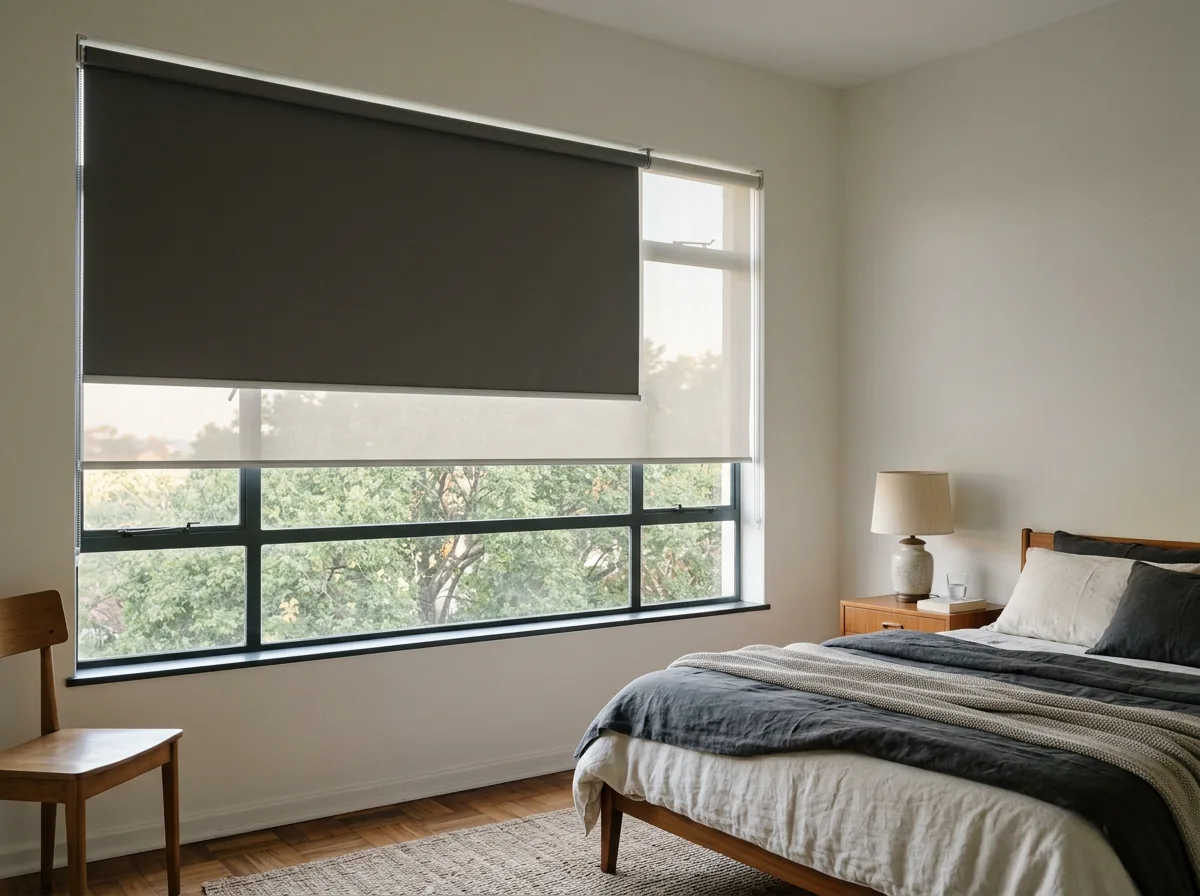
A double roller in an Illovo bedroom: a charcoal blockout blind pulled two-thirds down with a pale sunscreen mesh behind it, both single flat sheets on one bracket, tree canopy visible below
Double roller, one bracketBlockout in front, sunscreen behind.

South rooms and winter comfort

Cellular / honeycomb blinds

Why here

The cells hold still air against the glass, insulating both ways. Where June nights sit near 4°C and single glazing is the norm, you feel the difference.

The trade-off

Honeycomb does not manage glare the way a mesh does, and it is no view product — raised it is lovely, lowered a wall.

Balconies, patios and covered terraces

Zip screens — and folding-arm awnings where there's no soffit

Why here

A zip screen's fabric runs in side channels, so it stays locked in wind instead of flogging about — the whole argument on a Highveld November afternoon.

The trade-off

Side channels need something solid on both sides, and on a sectional-title balcony those walls are common property. An awning needs no side fixings but must be motorised with a wind sensor.

Ground-floor and boundary-facing windows

Roller shutters

Why here

Aluminium slats roll down over the outside of the glass on their own guides, so heat, glare and light are dealt with before they reach the room.

The trade-off

There is a headbox on the facade — on a sectional-title building, an external-appearance change needing consent. Interior blinds avoid that; they just cannot beat the shutter on heat.

Shading, not security. Our roller shutters are made for sun, heat and glare control on the outside of the glass. They are not security-rated shutters — that is a different product, which we can quote on request.

Also on the list

Aluminium venetian blinds

Moisture-proof; tilt steers light onto the worktop. Trade-off: they collect dust.

Timber venetian blinds

Warmer against parquet. Trade-off: not for a steamy bathroom.

Vertical or panel blinds

Wide sliders: tilt for light, draw off the opening. Trade-off: they move in a draught.

Concealed / recessed blinds

Drops from a ceiling slot, hardware hidden. Trade-off: plan before the ceiling closes.

Skylight & shaped-window blinds

Gables, arches and skylights, guided to hold position. Trade-off: needs motorising.

Motorisation

One control per elevation, no cord in reach; battery motors need no wiring. Trade-off: cost per blind.

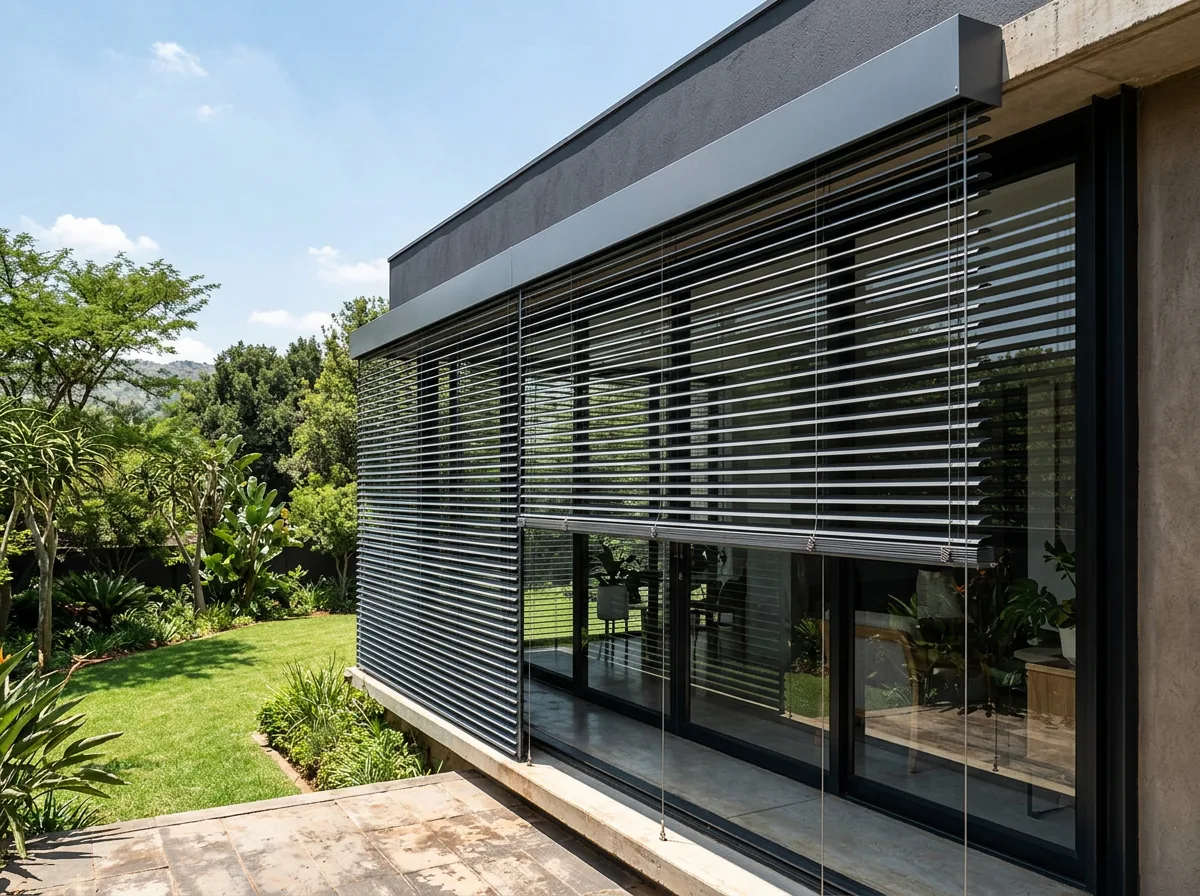
External venetian blind mounted outside a wall of glass on a Johannesburg home — horizontal aluminium slats hanging in guide cables from a slim headbox, tilted against the high midday sun
Outside the glassExternal venetians hang clear of the pane, intercepting heat before it becomes a warm room.

05 — Blocks, trustees & pressed ceilings

In Illovo, the inside/outside line is a real fork.

So much of this suburb is sectional title that where the product sits — inside the section or on the outside wall — changes the whole conversation. Under the prescribed conduct rules an owner may not change the external appearance of a section without the trustees' written consent, unless the change is minor and does not detract from the appearance of the section or the common property. Outer walls are common property, so anything fixed to them — awnings, external screens, a roller-shutter headbox — needs that consent.

It is rarely a wall. Awnings on north and west windows are described as common practice and unreasonable to refuse; the governing rule is harmonious appearance, which is really a question about colour and profile. That makes “what will the trustees accept” a design input, not paperwork — so we specify slim, colour-matched profiles for complex work and hand owners the documentation to submit.

The period stock adds its own. Those 1950s and '60s blocks kept high — often pressed — ceilings, solid walls and generous openings. Deep openings suit fitting inside the reveal; a pressed ceiling is not somewhere to drill casually.

06 — Honest limits

What we'd still need to check on site.

Everything above is what the suburb and the sun will tell you. These five need a tape measure and a look — and getting them wrong is what makes a blind fit badly, or not at all.

07 — Two ways forward

Book the measure, or price it yourself first.

Both free, neither commits you. The measure gives exact per-window pricing; the window list gives a budget range with nobody setting foot in the house.

The proper answer

Book your free expert measure

  • A consultant measures every opening precisely, on site.
  • Samples judged in your own light.
  • A written quote, itemised per window. No obligation.

It costs nothing and settles all five on-site questions in one visit.

If you'd rather not book yet

Your ballpark, in about two minutes

Want a ballpark first? Pop in rough sizes and we'll send a budget range by the next working day. Not sure how to measure? Leave it — our consultant measures for free and you'll get exact per-window pricing instead.

The window list

Rough sizes, a budget range by the next working day.

Measure the opening itself — width first, then drop, at the widest and longest point. Round to the nearest 10mm; nothing here is binding and we re-measure everything before anything is made. Anything you added while reading is already in the list.

RoomWidth (mm)Drop (mm)FitProductRemove row

Print it, walk the house with a pen, and type it in when you're back at the desk. Nothing is sent anywhere until you send the enquiry below — and if measuring isn't your idea of a Saturday, skip it entirely: the free measure does it properly and gives you exact per-window pricing.

The free measure & written quote visit

Have an expert do it properly.

A consultant comes to the windows, measures every opening, brings samples you can judge in your own light, and leaves you with a written quote itemised per window. It is free, there is no obligation, and nobody phones to push afterwards.

We use these details only to arrange your consultation call-back (POPIA). No marketing lists, no sharing. Choose “still researching” and we simply won't call.

Before you go

Take the Ledger with you, marked up for your rooms.

Same guide, with notes on your elevations. One email, nothing else.

Used only to send the guide and, if you ask, to arrange a call-back (POPIA). Never shared.

Sources

Where the facts in here come from.

Sun angles, climate and suburb history are quoted from published sources. The specification reasoning and the trade-offs are our own, from fitting blinds in buildings like these.

  1. Illovo coordinates, boundaries and landmarks — Wikipedia: Illovo, Gauteng
  2. Illovo's 1950s–60s apartment stock, pressed ceilings, solid walls, parquet and leafy streets — PrivateProperty: Illovo area and property guide and In Your Pocket: Illovo & Melrose
  3. Sun altitude at the solstices for 26° south — worlddata.info: sun altitude, South Africa; Johannesburg sun data — geotimedate; day lengths — timeofsunrise: Johannesburg solstices
  4. Orientation logic for southern-hemisphere north, east and west elevations, and the limits of overhangs — Passive solar orientation: east and west elevations and Mimiti: passive solar design in South Africa
  5. Johannesburg altitude and UV index; UV rise with elevation — Johannesburg UV index
  6. Highveld storm season, hazards, and the October–November severe-storm peak — Mail & Guardian: the South African Weather Service on the storm season and The Citizen: thunderstorms and damaging hail
  7. Winter and early-spring berg winds; Johannesburg temperatures — Climates to Travel: Johannesburg and Weather Atlas: Johannesburg climate
  8. Jacarandas are deciduous and concentrated in Joburg's older northern suburbs — In Your Pocket: jacaranda streets and Madison Manor: jacaranda trees in South Africa
  9. Trustees' written consent for changes to external appearance; outer walls as common property; awnings and the harmonious-appearance rule — Paddocks: actions trustees can approve and Portfolio Property: sectional title alterations